The Gospel of Mary Magdalene: A Comprehensive Overview
Digital accessibility of the Gospel of Mary Magdalene is increasing, with PDF versions readily available online from various sources for scholarly study.
Numerous websites offer free downloads, including options for reading the text online, facilitating wider access to this important Gnostic document.
Researchers and enthusiasts can explore Karen L. King’s translation in PDF format, alongside other resources detailing copyright and preservation efforts.
These digital copies ensure the text’s longevity and allow for broader engagement with its unique theological perspectives and historical significance.
Historical Context & Discovery
The Gospel of Mary Magdalene’s journey to modern awareness began with fragmented discoveries in the 19th and 20th centuries, initially through papyrus fragments. Crucially, portions were identified within the Oxyrhynchus Papyri (P. Oxy. 3525), unearthed in Egypt, offering early glimpses into its content. However, a more substantial portion surfaced with the Nag Hammadi Library discovery in 1945, a collection of Gnostic texts found near the Egyptian town of Nag Hammadi.
The John Rylands Manuscript (P. Rylands 463), held in Manchester, also contains fragments, contributing to the reconstruction of the text. These discoveries revealed a text dating back to the 2nd century AD, challenging traditional understandings of early Christian history. The availability of PDF versions of translations, like Karen L. King’s work, has dramatically increased accessibility, allowing scholars and the public to engage with this historically significant document. The text’s rediscovery sparked intense debate and reevaluation of Mary Magdalene’s role within early Christianity.
The Nag Hammadi Library and its Significance
The Nag Hammadi Library, discovered in 1945, fundamentally altered our understanding of early Christian diversity, and within it, the Gospel of Mary Magdalene holds a prominent place. This collection of Gnostic texts, found in thirteen codices, provided a counterpoint to the canonical Gospels, revealing alternative perspectives on Jesus’ teachings and the roles of his disciples.
The library’s significance lies in its preservation of texts previously unknown or suppressed, offering insights into the complex theological landscape of the 2nd century. The Gospel of Mary’s inclusion challenged traditional hierarchies and highlighted Mary Magdalene’s unique spiritual authority. Today, readily available PDF versions of translations, like those by Karen L. King, allow for widespread study of this crucial text. The library’s discovery facilitated a re-examination of early Christian history and the diverse interpretations of faith.
The John Rylands Manuscript (P. Rylands 463)
P. Rylands 463, housed at the John Rylands University Library of Manchester, represents a crucial fragment of the Gospel of Mary Magdalene, offering invaluable insight into the text’s earliest physical form. Dating back to the 3rd century, this papyrus fragment is one of the oldest known copies, predating the complete texts found at Nag Hammadi.
Its significance lies in confirming the antiquity of the Gospel and providing textual evidence for scholarly reconstruction. High-resolution images of P. Rylands 463 are often included in digital resources, and PDF versions of scholarly articles frequently feature its photographic representation. Access to these resources allows researchers to examine the manuscript firsthand, even remotely. The manuscript’s preservation is vital for understanding the Gospel’s transmission and historical context, enriching the study of early Christian literature.
The Oxyrhynchus Papyri (P. Oxy. 3525)
P. Oxy. 3525, discovered amongst the Oxyrhynchus Papyri in Egypt, constitutes another significant fragment of the Gospel of Mary Magdalene, complementing the evidence provided by P. Rylands 463. This fragment, also dating to the 3rd century, offers further textual variations and insights into the Gospel’s composition.
The Ashmolean Museum, University of Oxford, holds this important piece, and photographs of P. Oxy. 3525 are frequently incorporated into digital publications and scholarly PDF documents. These digital reproductions enable detailed examination of the papyrus’s physical condition and script. Access to these resources is crucial for comparative textual analysis and understanding the Gospel’s evolution. The preservation and digitization of this fragment are essential for continued research and broader accessibility.

Content and Themes of the Gospel
PDF versions reveal the Gospel’s focus on Mary Magdalene’s unique spiritual insights and her pivotal role as a favored disciple of Jesus Christ.
Mary Magdalene’s Role as a Disciple
The Gospel of Mary Magdalene, accessible in PDF format, dramatically redefines Mary’s position within the early Christian narrative, presenting her not merely as a follower, but as a key disciple possessing profound spiritual understanding.
Unlike the canonical gospels, this text highlights Mary’s direct reception of revelations from Jesus, surpassing even that of the male apostles. PDF analyses of the text demonstrate that she is portrayed as uniquely capable of comprehending Jesus’s teachings, particularly concerning the nature of the soul and its ascent to the divine realm.
The PDF document reveals that Mary shares these insights with the other disciples, leading to doubt and challenge, notably from Peter, who questions her authority. This dynamic underscores a tension between differing interpretations of Jesus’s message and the emerging hierarchical structure within the early church. The availability of the Gospel in PDF allows scholars to closely examine this portrayal and its implications for understanding the historical role of women in early Christianity.
The Disciples’ Doubt and Peter’s Challenge
The Gospel of Mary Magdalene, readily available as a PDF, vividly depicts the disciples’ initial skepticism towards Mary’s revelations, particularly focusing on Peter’s forceful challenge to her authority. Examination of the PDF reveals Peter questioning how Mary could possess knowledge surpassing that of Jesus himself, reflecting a patriarchal bias prevalent in the early church.
This challenge, detailed within the PDF text, isn’t simply a theological disagreement; it represents a struggle for leadership and control over the interpretation of Jesus’s teachings. Levi defends Mary, acknowledging her spiritual insight, but the tension remains palpable.
The PDF format allows for close textual analysis, highlighting the power dynamics at play and the resistance to a female voice holding significant spiritual authority. This scene underscores the Gnostic Gospel’s critique of established hierarchies and its emphasis on direct, personal experience of the divine, a concept challenging the disciples’ conventional understanding.
Mary’s Vision and Ascension Narrative
The Gospel of Mary Magdalene, accessible in PDF format, features a compelling vision narrative where Mary receives direct revelation from Jesus after his resurrection. Studying the PDF reveals Mary’s ascent through various powers and realms, encountering both resistance and guidance on her spiritual journey.
This ascension, detailed within the PDF, isn’t a physical departure but an inner transformation, a liberation of the soul from earthly constraints. She receives knowledge about the nature of reality and the path to spiritual liberation, insights she then shares with the disciples.
The PDF allows for careful examination of the symbolic language used to describe Mary’s vision, highlighting its Gnostic cosmology and emphasis on inner knowledge. This narrative challenges conventional notions of salvation and emphasizes the importance of personal experience and spiritual insight, making the PDF a valuable resource.
Gnostic Teachings within the Gospel
The Gospel of Mary Magdalene, readily available as a PDF, is deeply rooted in Gnostic thought, diverging significantly from orthodox Christian doctrines. Examining the PDF reveals a focus on gnosis – inner, experiential knowledge – as the key to liberation from the material world.
The PDF showcases teachings concerning the illusory nature of reality and the divine spark within humanity, trapped in a flawed creation. This contrasts with the canonical gospels’ emphasis on faith and obedience. The text, in PDF form, emphasizes the soul’s ascent to the divine realm.
Analyzing the PDF demonstrates a rejection of the creator God of the Old Testament, viewed as a lesser, imperfect deity. The Gospel of Mary Magdalene, through its PDF accessibility, offers a unique perspective on salvation and the nature of the divine, challenging traditional theological frameworks.
The Nature of the Soul and its Ascent
The Gospel of Mary Magdalene, accessible in PDF format, presents a complex understanding of the soul’s origin and destiny. The PDF reveals the soul as a divine spark, originating from a higher spiritual realm and temporarily imprisoned within the material body.
Through gnosis – inner knowledge – detailed within the PDF, the soul can remember its true nature and initiate its ascent back to the divine source. This ascent, as described in the PDF, isn’t a physical journey but a spiritual awakening.
The PDF emphasizes overcoming the passions and attachments of the material world, which bind the soul to the cycle of reincarnation. Mary’s vision, detailed in the PDF, illustrates this process, offering a roadmap for spiritual liberation and reunion with the divine.
The Rejection of Material World
The Gospel of Mary Magdalene, readily available as a PDF, strongly advocates for detachment from the perceived illusions of the material realm. The PDF portrays the physical world as a source of suffering and ignorance, hindering the soul’s true potential.
Within the PDF, worldly desires and attachments are depicted as chains that bind individuals to the cycle of birth and death, preventing their spiritual ascent. The text, accessible in PDF format, emphasizes the importance of inner knowledge – gnosis – over external, material pursuits.
The PDF suggests that true liberation comes from recognizing the impermanence and unreality of the material world, and focusing instead on cultivating a connection with the divine, inner self. This rejection, detailed in the PDF, is central to the gospel’s core teachings.

Analysis and Interpretation
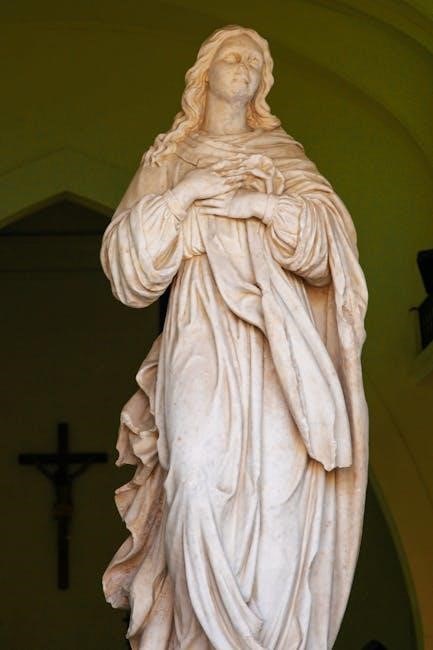
PDF versions facilitate detailed textual analysis, revealing Gnostic cosmology and contrasting with canonical gospels, prompting feminist theological discussions and scholarly debate.
Karen L. King’s Translation and Commentary
Karen L. King’s groundbreaking work, “The Gospel of Mary of Magdala: Jesus and the First Woman Apostle,” provides a meticulously researched translation and insightful commentary, often available in PDF format.
Her translation, derived from the John Rylands Manuscript (P. Rylands 463) and Oxyrhynchus Papyri (P. Oxy. 3525), offers a nuanced understanding of the text’s complexities.
King’s commentary contextualizes the gospel within its historical and religious milieu, exploring its Gnostic themes and challenging traditional interpretations of early Christian history.
The PDF version of her book allows scholars and enthusiasts to closely examine her arguments regarding Mary Magdalene’s pivotal role as a disciple and apostle.
King’s work highlights the significance of this text in reshaping our understanding of Jesus’ teachings and the early Christian movement, particularly concerning female leadership.
Her detailed analysis, accessible through the PDF, illuminates the gospel’s radical interpretation of spiritual knowledge and its implications for modern religious thought.
Gnostic Cosmology and its Influence
The Gospel of Mary Magdalene, often studied via accessible PDF versions, deeply reflects Gnostic cosmology, a complex system of beliefs diverging from mainstream Christianity.
Central to this cosmology is the concept of a flawed material world created by a lesser deity (the Demiurge), and the existence of a higher, unknowable God.
The PDF text reveals a focus on the soul’s ascent back to this divine realm through gnosis – inner spiritual knowledge – rather than faith or good deeds.
This Gnostic influence shapes the gospel’s narrative, emphasizing Mary Magdalene’s unique understanding of Jesus’ teachings and her ability to impart this knowledge.
Studying the PDF allows examination of how the text rejects the material world’s limitations, advocating for a spiritual liberation achieved through self-discovery.
The gospel’s cosmology, readily available in PDF format, significantly impacted early Gnostic thought and continues to fascinate scholars today.
Comparison with Canonical Gospels
Analyzing the Gospel of Mary Magdalene, often accessed through convenient PDF downloads, reveals striking differences from the canonical Gospels of Matthew, Mark, Luke, and John.
While canonical texts emphasize Jesus’ death and resurrection for salvation, the PDF version of Mary’s Gospel prioritizes inner spiritual knowledge (gnosis) as the path to liberation.
Unlike the canonical accounts, Mary Magdalene is presented as a key disciple possessing unique insights, challenging traditional patriarchal structures.
The PDF demonstrates a distinct lack of focus on Jesus’ lineage or miraculous events, instead centering on his esoteric teachings and the disciples’ struggles to understand them.
Comparing the PDF text with canonical Gospels highlights differing theological perspectives and narrative priorities, offering a contrasting view of Jesus’ message.
This comparison illuminates the diversity of early Christian thought and the reasons for the exclusion of texts like Mary’s Gospel from the biblical canon.
Theological Implications of Mary’s Revelation
The Gospel of Mary Magdalene, readily available as a PDF, presents profound theological implications challenging traditional Christian doctrines.
Its emphasis on gnosis – direct, experiential knowledge of the divine – contrasts with reliance on faith or institutional authority, as seen in the PDF text.
Mary’s revelation suggests a more fluid and less hierarchical understanding of the divine, potentially diminishing the emphasis on a singular, male God.

The PDF reveals a focus on the inherent divinity within each individual, advocating for a personal spiritual journey rather than external salvation.
This challenges conventional notions of sin and redemption, proposing liberation through self-knowledge and understanding of the soul’s ascent.
Studying the PDF prompts re-evaluation of early Christian beliefs and the role of women in shaping theological discourse.
Feminist Perspectives on the Gospel
The accessibility of the Gospel of Mary Magdalene in PDF format has been pivotal for feminist theological scholarship, offering a counter-narrative to patriarchal interpretations of Christianity.
The PDF text highlights Mary Magdalene as a key disciple and possessor of unique spiritual insight, challenging the historical marginalization of women in religious leadership.
Feminist readings emphasize Mary’s authority and independent understanding of Jesus’ teachings, reclaiming her as a legitimate source of theological wisdom.
The PDF’s portrayal of Mary’s vision and ascension narrative provides a powerful symbol of female empowerment and spiritual agency.
Analyzing the PDF reveals a critique of the male disciples’ doubt and Peter’s challenge to Mary, interpreted as resistance to female authority.
This gospel, in PDF form, offers a valuable resource for reconstructing a more inclusive and equitable understanding of early Christian history.

The Gospel of Mary Magdalene PDF & Accessibility

PDF versions of the Gospel of Mary Magdalene are widely available online, offering convenient access to this important Gnostic text for researchers.
Availability of PDF Versions Online
Numerous online platforms host PDF versions of the Gospel of Mary Magdalene, catering to diverse academic and personal interests. Internet Archive provides access to Karen L. King’s translation, alongside other related texts, enabling free download, borrowing, and streaming options.
DOKUMEN.PUB also features a readily accessible PDF copy, often cited for its comprehensive presentation of the text. Websites dedicated to Gnostic studies and early Christian literature frequently offer downloadable PDFs, facilitating in-depth research and analysis.
These resources vary in quality and completeness, so verifying the source and translation is crucial. Many university libraries and theological institutions also provide digital access to the gospel in PDF format through their online databases, ensuring scholarly rigor and reliability.
Reliable Sources for Download
For trustworthy PDF downloads of the Gospel of Mary Magdalene, prioritize academic institutions and established digital libraries. The Internet Archive stands out as a consistently reliable source, offering Karen L. King’s translation and associated scholarly materials.
University library databases, accessible through institutional affiliations, provide vetted PDF versions, ensuring accuracy and scholarly integrity. Websites affiliated with reputable theological societies or Gnostic research centers also offer dependable downloads.
Exercise caution with less-known websites, verifying the source’s credibility and the translation’s accuracy. DOKUMEN.PUB can be useful, but cross-reference with academic sources. Always check for clear copyright information and avoid sites with suspicious download practices to ensure a safe and legitimate access experience.
Copyright and Usage Considerations
When accessing PDF versions of the Gospel of Mary Magdalene, understanding copyright is crucial. While the text itself is ancient, modern translations – like Karen L. King’s – are protected by copyright law.
Generally, downloading a PDF for personal study is permissible, but redistribution, commercial use, or publication requires explicit permission from the copyright holder. Many academic institutions offer licenses for educational purposes.
Always respect the terms of use specified by the source providing the PDF. Proper attribution is essential when quoting or referencing the text in academic work. Be mindful of fair use guidelines and avoid unauthorized duplication or alteration of the translated material.
Digital Preservation Efforts
Recognizing the importance of long-term access, several institutions are actively engaged in the digital preservation of the Gospel of Mary Magdalene, including its PDF versions. The John Rylands Library and the Ashmolean Museum, custodians of original fragments, contribute to these efforts.
Initiatives involve creating high-resolution scans of the papyri and ensuring the longevity of digital translations. Metadata standards are applied to PDF files for improved discoverability and interoperability.
Organizations like the Internet Archive also play a vital role by archiving and providing access to various PDF copies. These collaborative endeavors safeguard this significant Gnostic text against loss or degradation, ensuring its availability for future generations of scholars and researchers.

Scholarly Debate and Criticism
PDF accessibility fuels ongoing debates about authenticity, authorship, and dating, prompting critical analysis of translations and theological implications within the text.
Authenticity and Authorship Discussions
The availability of the Gospel of Mary Magdalene in PDF format has significantly broadened scholarly engagement, intensifying discussions surrounding its authenticity and origins. Critics debate whether the text represents a genuine early Christian tradition or a later Gnostic composition.
The fragmented nature of surviving manuscripts, including the PDF versions derived from the Oxyrhynchus Papyri and the Nag Hammadi Library, complicates establishing a definitive textual history. Questions persist regarding potential interpolations or alterations made during transmission.
Authorship remains uncertain; while attributed to Mary Magdalene herself within the text, scholars generally believe it was likely written by a follower or within a community influenced by her legacy. PDF analysis allows for detailed comparative study with other Gnostic texts, potentially revealing shared literary conventions or ideological influences, aiding in tracing its intellectual lineage.
Ultimately, the debate centers on interpreting the evidence presented in these PDF documents and assessing the historical context of its creation.
Dating the Text and its Origins
PDF versions of the Gospel of Mary Magdalene, derived from fragmented papyri, contribute to ongoing debates about its precise dating and geographical origins. Paleographic analysis of the handwriting in these PDF scans suggests a likely composition date in the second century CE, specifically between 180-200 CE.
The text’s Coptic language, evident in the PDF translations, indicates its final form originated in Egypt, likely within Gnostic communities flourishing in that region. However, scholars theorize the underlying Greek original may be older.
Comparative linguistic studies, facilitated by readily available PDF copies, reveal connections to other Gnostic texts from the Nag Hammadi library, suggesting a shared intellectual milieu. Determining the precise origins requires careful consideration of textual evidence and historical context, all accessible through these digital formats.
The PDF format allows for detailed scrutiny of these clues.
Theological Controversies Surrounding the Gospel
The Gospel of Mary Magdalene, accessible in PDF format, sparks theological debate due to its differing portrayal of Jesus’ teachings and the disciples’ reactions. Its emphasis on inner spiritual knowledge, as presented in PDF translations, contrasts with the more externally focused sacraments of orthodox Christianity.
Peter’s challenge to Mary’s authority, visible in PDF versions of the text, raises questions about early Christian views on female leadership and apostolic succession. The Gnostic cosmology within the PDF document, focusing on the soul’s ascent, clashes with traditional doctrines of salvation;
Some interpret the gospel as a legitimate alternative perspective, while others view it as heretical. The availability of PDF copies fuels ongoing discussions about its place within the broader Christian tradition and its implications for understanding early Christian diversity.

Scholarly analysis of the PDF is crucial.
Impact on Modern Religious Thought
The widespread availability of the Gospel of Mary Magdalene in PDF format has profoundly impacted modern religious thought, particularly within feminist theology and Gnostic studies. Its portrayal of Mary Magdalene as a key disciple, readily accessible through PDF downloads, challenges traditional patriarchal interpretations of Christian history.
The text’s emphasis on direct spiritual experience, easily studied via PDF versions, resonates with contemporary seekers exploring alternative spiritual paths. The PDF’s accessibility has fueled discussions about the suppression of female voices in early Christianity and the potential for a more inclusive theology.
Scholars utilizing the PDF are re-evaluating the canon and exploring the diversity of early Christian beliefs. This has led to a renewed appreciation for Gnostic perspectives and a questioning of established religious norms, impacting interfaith dialogue and spiritual practices.
Related Texts and Resources
PDF access to the Dialogue of the Savior and Sophia of Jesus Christ complements study of the Gospel of Mary Magdalene, enriching Gnostic understanding.
The Dialogue of the Savior
The Dialogue of the Savior, another Nag Hammadi text frequently studied alongside the Gospel of Mary Magdalene, offers valuable comparative insights, often found in PDF format online.
Like Mary’s Gospel, it presents a unique perspective on Jesus’ teachings, emphasizing inner knowledge and spiritual understanding over ritualistic observance, and is often available for free download.
Scholars exploring the Gospel of Mary Magdalene in PDF often turn to the Dialogue to examine common Gnostic themes, such as the nature of reality and the path to liberation.
Both texts challenge conventional interpretations of early Christian beliefs, providing alternative narratives about Jesus’ disciples and their understanding of his message, readily accessible in digital form.
Analyzing both texts in PDF allows for a deeper appreciation of the diversity within early Christian thought and the role of women in shaping these traditions.
The Sophia of Jesus Christ
The Sophia of Jesus Christ, another significant Gnostic text, complements the study of the Gospel of Mary Magdalene, with both frequently available as PDF downloads for academic and personal exploration.
This text, like Mary’s Gospel, delves into complex theological concepts, particularly concerning divine wisdom (Sophia) and its role in the cosmos, often found in digitized collections.
Researchers examining the Gospel of Mary Magdalene in PDF format often consult Sophia of Jesus Christ to understand broader Gnostic cosmological frameworks and their influence.
Both texts showcase a focus on inner spiritual experience and a rejection of purely material interpretations of reality, readily accessible through online resources.
Comparing these texts in PDF format reveals shared themes and unique perspectives within Gnostic Christianity, enriching our understanding of early religious diversity.
Other Gnostic Gospels
Exploring the Gospel of Mary Magdalene in PDF format naturally leads to examining other Gnostic texts, many of which are also available digitally for comparative study.
Texts like the Gospel of Thomas and the Gospel of Philip, frequently found as PDF downloads, offer alternative perspectives on Jesus’ teachings and early Christian beliefs.
These texts, alongside Mary’s Gospel, challenge traditional interpretations and highlight the diversity of thought within early Christianity, accessible through online archives.
Researchers often utilize PDF versions to conduct textual analysis, identifying common themes and unique characteristics within the Gnostic corpus.
Studying these interconnected texts in PDF format provides a richer understanding of Gnostic cosmology, soteriology, and the role of revelation in early religious movements.